How I Worldbuild Tools for Children to Fight Wars
A century of war makes for a lot of lost children. At least, that’s true of my Drifting Amalgams universe. How do they cope? Join the war that spawned them.
These are the real-world technologies behind my narrative’s warbots–for children.
Rather watch a video?
Check out the YouTube version of this blog post.
Operators and Operations: The User and Interface of the R-Cat
To be clear, I don’t take the realities of war or child soldiering lightly. My narratives, like many sci-fi works, touch on war themes, and in real life, war leaves many children displaced.
In my storyline, these children were born into a region that was being conquered., and I wanted to give them a way to fight back.
Curiously, the idea of child-operated robots came to me when I learned about roboticist Elena García Armada who focuses on exoskeletons for children. Her work helps children with spinal cord injuries walk. A real innovation for bringing a sense of power to people facing challenges in life.
So, I began imagining war-injured children with this technology.
Yeah… few problems with that. The story that followed would have a bunch of traumatized kids–with expensive suits–wandering around active combat zones.
I needed to make the concept a bit more believable. And I wanted to be able to add some intrigue.
Let’s start by removing these child soldiers from the frontlines.
I can do this through the use of remote control. Militaries use drones from remote locations,

so no problem there.
I want something ground-based, though, that can interact with other characters.
I can draw from real-world military robots here.
As well as aerial drones, modern-day militaries employ bomb disposal bots, unmanned tanks, and robotic MULEs.
MULEs are an interesting one for my build since one of their variations is designed with reconnaissance and surveillance in mind. This focus mirrors the real-world spying and messengering tasks that children often carry out in war.
Still, a child is not going to have the understanding and wisdom to know what to do with much of what they’re seeing, so taking another page from modern military robots, I’ll have the systems of my warbots function semi-autonomously. AI algorithms will analyze camera feeds, detect enemy movement, track targets, and carry out firing solutions.
And what, you may be wondering, do these MULES look like? This is where it gets fun.
Creating a Warbot that Blends into its Surroundings
The design of this robot stems directly from the ideologies and fears of my narrative’s aggressors.
See, Oomfr’crumf Nation’s leadership believes in a one-planet nation. And they’ll claim it any way they can.
Except with the help of nations from other planets.
When the leopard-like peoples of the planet Barpadai proposed a partnership, Oomfr’crumf’s jingoistic beliefs took hold. They turned the big cats away–insulting them with comparisons to wild animals found in the forest.
The problem with this was that the peoples of Barpadai are far more technologically advanced. And the Independent States that Oomfr’crum Nation has brought war to have no qualms with interstellar trade.
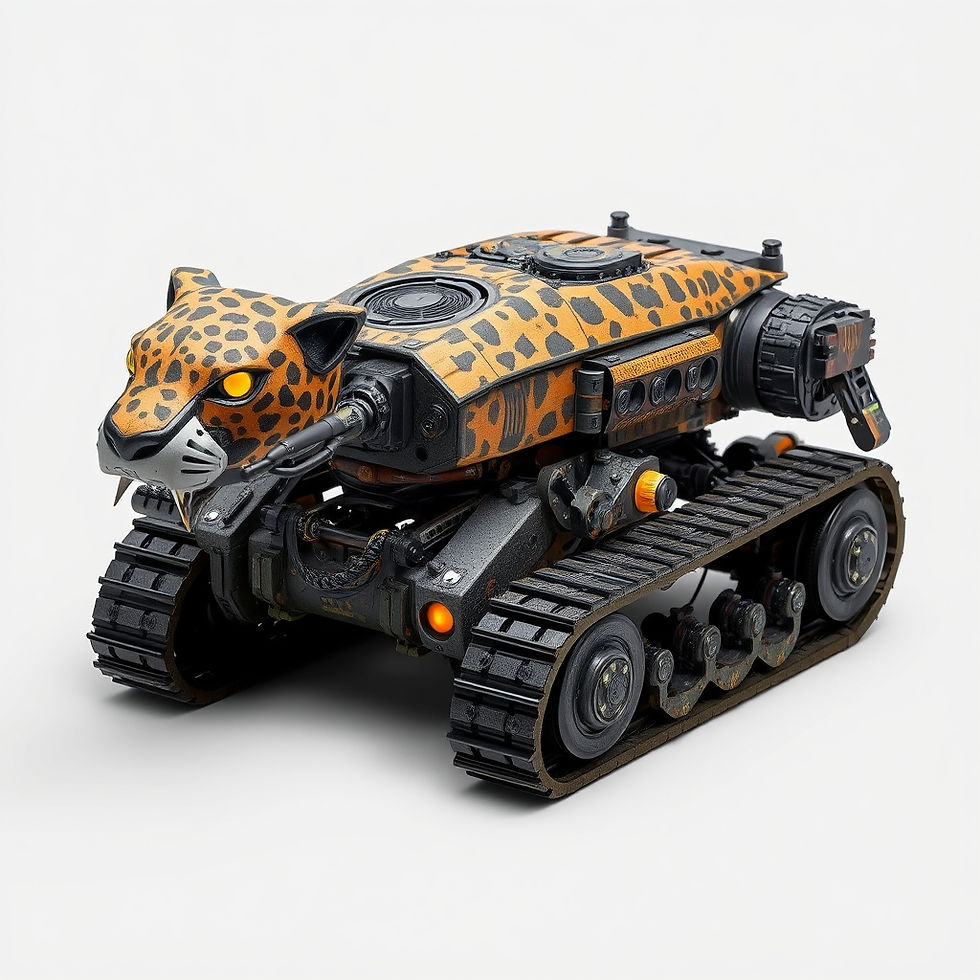
And since Oomfr’crumf Nation is so averse to big cats, it only makes sense to develop a stealth robot that looks like one. And as you can imagine, building a robot in your own people’s image came naturally to the leopard-like peoples of Barpadai.
Enter the Automated Reconnaissance Assistant.
A leopard-like warbot may seem far-fetched, but DARPA actually envisioned something like this. Called the LS3, the now-shelved prototype was hoped to be a highly mobile, semi-autonomous legged robot. Reportedly, it could carry 400 lbs of gear across various terrains while interacting with troops like a trained animal.
Where a MULE is usually on four wheels, the LS3 had four legs. It looked kinda like a headless cow.
So, back to my leopard-like warbot.
I want it to have a head and a full cat body.
And since, like the LS3, these robots are built for real-world chaos, they can endure dust, explosions, and unpredictable movement. Basically, it can surveil the Independent States unbothered.
And since the LS3 was taken offline due to lawnmower-like noise, I’ll be sure to worldbuild my robot to have other-worldly sound dampening. Similarly, to help with the “I’m just a big cat’ ruse, the Automated Reconnaissance Assistant will receive regular updates to make it look like the ever-evolving animals of the forest.
But the enemy is likely to discover this technology eventually. So what’s to stop them from taking and reprogramming a robot or two.
Securing the Vulnerabilities of a Robotic War-Cat
Real-world military robots are vulnerable to cyber threats: Radio links and GPS navigation can be hacked or jammed.
So, I’ll make sure my sci-fi robots are not connected to any communications systems that Oomfr’crumf Nation understands. Once again, this is where the Independent States have an advantage. They can use technology from their benefactors and not worry about it being hacked by their jingoistic enemies.
But there’s still the matter of a physical robot being discovered out in the wild. It could be used or, eventually, understood through reverse engineering.
I’ll need to include some way to lock it out from prying hands.
I’m thinking some sort of DNA security feature. Similar to a handprint or retinal scan… but maybe breath? And it’ll need two authorized people to unlock or operate it.
From a security perspective, that should take care of everything.
Well, except, there are a lot of planets out there. And many of them have similar if not more advanced technology than what’s used for the Automated Reconnaissance Assistant. Off-planet pirates could probably hack these robots. But why would they bother the war-devestated and resource-rich Independent States?
Come to think of it, there is another security risk: treason. …But a war-exhausted citizen from the Independent State wouldn’t share secrets with the luxury-filled and safe Oomfr’crumf Nation? Right?
Until next time, stay curious.