Worldbuilding a Sci-Fi Transit Vehicle: Quick Breakdown & Tips
I’m sci-fi writer Casey Hudson, and I’m worlbuilding a transit system for my Drifting Amalgams universe. Here are the worldbuilding questions I’m asking and how I’m answering them to create a transportation network.
Rather watch a video?
Check out the YouTube version of this blog post.
Build a Sci-Fi Transit System 101
Designing a network for transit can be complex. Or you can focus on three simple areas.
Infrastructure. Movement control. Environment.
Infrastructure breaks down to guidance, power, and safety. What’s guiding your vehicles’ velocity? What powers this guidance system? And what safety nets and emergency measures are in place when accidents happen?
Movement control. Whether you’re looking at city-level travel or orbital rights, someone is probably monitoring–if not controlling–movement. So, think about who’s being controlled and why.
Finally, environment comes down to what modes of transport, pathways, and vehicle designs are reasonable for your world. Building a water planet? You’re going to need watercraft. Like hoverboards? Stay away from frozen tundras.
See? Simple.
Now, let’s see what I can do with a mountainous planet.
Sci-Fi Transit: Geography Is Everything
Geography plays an important part in how transit functions and why it malfunctions.
For my most recent build, geography affects transportation types, equipment maintenance and failure, and transit mapping.
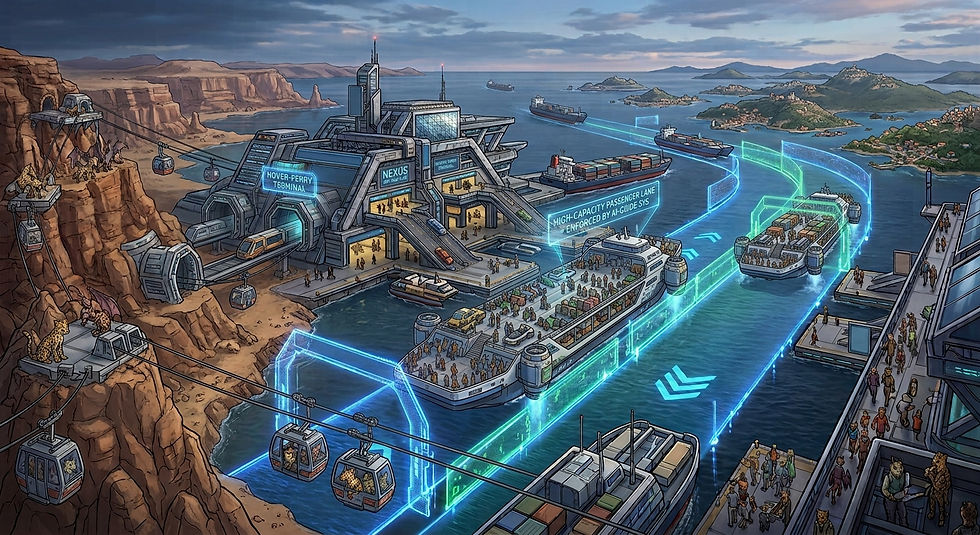
The geography of my planet Barpadai is similar to the US. So, I can use land, air, and water for transporting people and goods. That’s trucks, planes, and boats.
Maintenance and accident prevention ward against oceanic fog, strong winds, and high humidity. For that, we’re looking at automated guidance, emergency warnings, and moisture shielding.
Even with these safety measures, I’ll need to place transit lines, hubs, and checkpoints strategically.
So hover lanes will be placed above broad deserts and grasslands. While checkpoints will be placed between landmasses and mountain ranges.
Looks like I’ve figured out the where and the what. …so, who’s using this transit?
Why Your Sci-Fi Transit Needs Biology
The average American travels under four miles to go to the grocery store.
And humans average between 66 and 90 minutes of travel a day. Regardless of the mode of transport or the distance covered.
Why does that matter for a transit worldbuild?
Benchmarking.
Much like humans, my species of pentapardi are not fast. Plus, they have terrible endurance. So, a four-mile trip probably still needs motorized transportation.
My tadaribrae, on the other hand, are fast and have great endurance.

So as I’m building transportation for them, I’m thinking broader than individual daily trips. They’ll need fast trans-continental travel, like a concorde plane, if they travel an average of 90 minutes daily.
Tadaribrae can also use motorized transit when transporting large groups of wandering children. For field trips and the like.
I guess that means it’s time to design a school bus.
Juvenile Tadaribrae Aerotransport Vehicle

Tadaribrae typically travel under their own power. Taking advantage of their superior winged speed and endurance.
Previously, groups of pups flew together to their destination. However, individuals who couldn’t keep up and those who were faster and bored often strayed from the pack—resulting in accidents and lost pups.
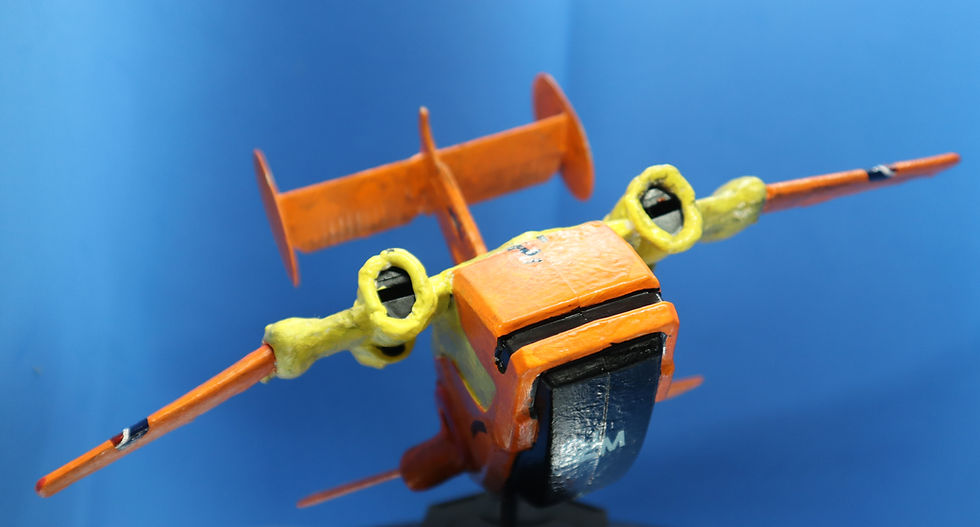
Enter, the Juvenile Tadaribrae Aerotransport Vehicle, or J-TAV.
The boxy shape of this motorized transport leaves room for interior racks. A system of bars for tadaribrae to hang comfortably. Each rack can be folded against the wall when not in use.
Not only is this convenient for adapting to group size, but this feature allows these vehicles to transport cargo when they're not being purposed for school.
The swing-wing design allows the J-TAV to fit into small cave-like structures that exist throughout the entirety of the planet. While they spend much of their time in the caves, tadaribrae also visit and spend time outside. Thus, the wings extend for more efficient flight.
An overall versatile build for a pragmatic culture.
Until next time, keep creating.