
Sci-Fi Models for On-Planet and Satellite Living
My sci-fi world has gotten pretty big. Which means I finally get to show you a little corner of my Drifting Amalgams universe. Join me for a look inside the cabinet as I tell you about the living situation among the elite of Oomfr’crumf Nation.
Rather watch a video?
Check out the YouTube version of this blog post.
How a Space Station became a Stellar State

Oomfr’crumf Nation initially launched space stations for exploration purposes. But when their values turned insular, the stations were transitioned into de facto military installations. And as the planetary defense mission grew, so did the stations.
Now completely constructed and repaired in space, these structures are built with little ground support. And they serve as the first defense against on-planet and extraplanetary threats–housing sophisticated weaponry and surveillance equipment as well as millions of Oomfr’crumf citizens.
With a population this large limited space and air are a consideration. To institute fairness while ensuring on-station safety, the Nation has imposed a population restriction. Each enlisted individual is allowed one immediate family member to accompany them during their time in the Interstellar States.

Many individuals reserve this allowance for a spouse or child who can easily adapt to the low-gravity environment.
Low on gravity but not absent of activities,
These bustling cities provide plenty of facilities to complete mandated exercise regiments.
Keeping all citizens fit and ready to return to the planet when called.
Transport from Satellite Homes to Treehouses: Space Hopper

Sometimes there’s on-planet work that only a station resident can complete. For those instances, military personnel secure passage via the extra-atmospheric passenger transporter.
Oomfr’crumf Nation space hoppers have an emergency pilot complement of two and can carry up to 100 passengers per trip.
After making a hard push to leave atmosphere, thrusters burn at a moderate pace for roughly four hours.

The whole trip is performed by the automated propulsion and navigation systems, so passengers experience a smooth ride every time.
No need for fancy seats or creature comforts for this short ride. Passengers just strap into the ergonomic plastic seats and cozy up to their neighbor.
Perfect, hassle-free transport to Ponga’s surface.
Living and Working in Interconnected Skyscraper Trees

Welcome to one of Prime Metropolis’ major government buildings.
Zoned with levels for industry, residences, and administration, government functions can be found at the top of the tree.
Aerial roots are trained to secure buildings to the side of the tree while engineered roots provide swinging playgrounds for children.
A large red communications antenna helps officials stay in touch with the rest of the forest city.
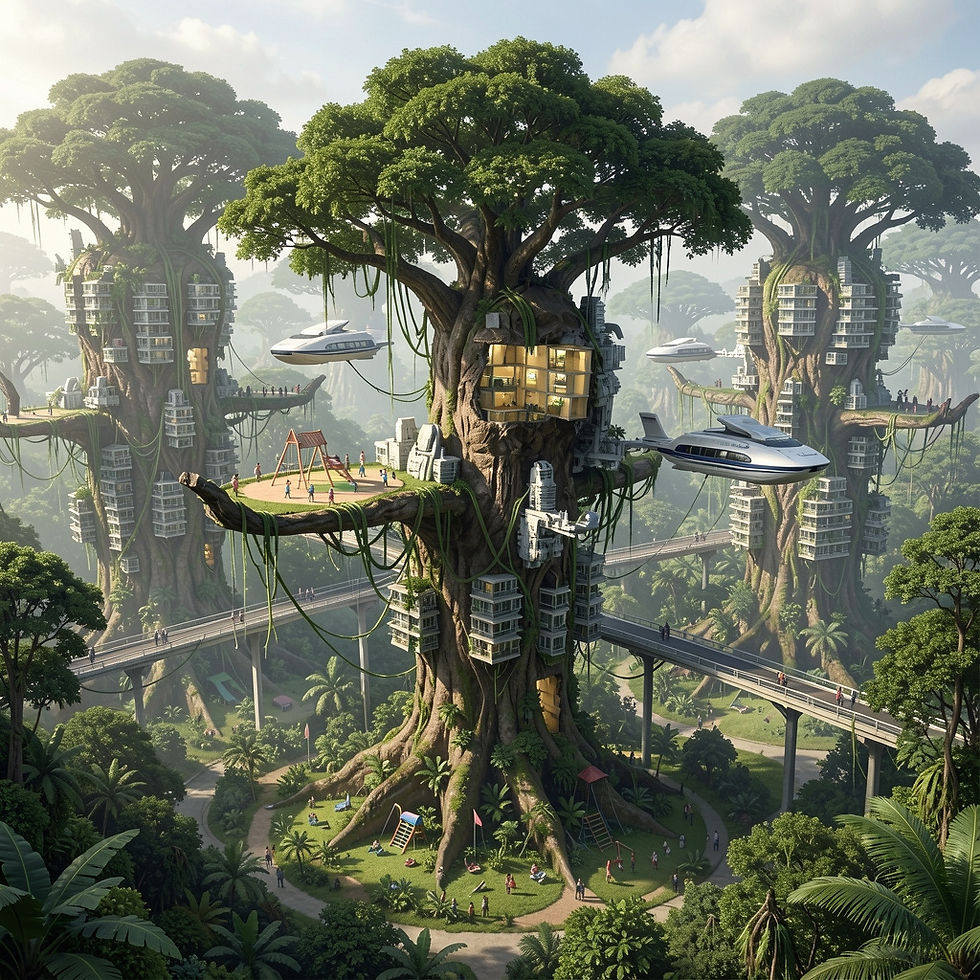
And since most transportation is aerial based, there are beacon lights on the tops of most structures to prevent collisions. This includes the park to keep children safe.
Po'ongabel rely on public transit for movement between trees. So transit stations are abundant for individuals–whether they need a maglev train to another tree in the city or a bus to another level on their current tree.
And with ground transport for cargo and skyways for short trips, Prime Metropolis is the perfect home for the cosmopolitan Nation citizen.
Until next time, keep creating.


