
Pointers for Building a Fictional Government from Scratch
Everything from wars to scientific advancements can hinge on a government’s values and structures. So governing bodies are an important part of worldbuilding, whether they’re on display or idling in a narrative’s background.
This is my approach to building a fictional government from scratch.
Rather watch a video?
Check out the YouTube version of this blog post.
Thinking about how to Choose a Fictional Government Type
An important thing to remember when creating a fictional government is that every government is an extension of society. Or, at the least, it was at some point. Governmental bodies often form and gain legitimacy because the citizenry want an assurance of security and wellbeing.
Take totalitarianism. It often starts with a need for order and stability. After experiencing war, economic collapse, corruption, or political disorder, a decisive ruler with a convincing message can be enticing.
Meanwhile, democracy offers a different type of security for a citizenry that prefers participation and accountability. It offers a belief in legislative control. And the ability to affect who’s in power.
With this concept in mind, how to choose a fictional government type has a few basic steps: Make sure you have a firm foundation for the culture. Then, really think about what it means to be part of the society you’re building.
Dissect it.

How is the society structured? Maybe it’s a hierarchy. Or perhaps it’s some other common structures like heterarchy, anarchy, or egalitarianism. Either way, your government structure is likely to follow suit. An egalitarian society, for instance, may prefer parliaments or councils.
In addition to societal structure, think about shared values. What values are commonly held by the governed? If your answer is individualism, democracy may be right for your culture.
Maybe the culture you’re building thrives in anarchy. For this, you’ll want to think about a decentralized approach. Localized governance, direct participation, or voluntary cooperation may be the best fit.
For my most recent build, I’m looking at a government that brings together the peoples of an entire planet. So shared values are especially important. More specifically, what common values necessitated the formation of this government.
Think of this like asking why the United Nations exists. Essentially, that answer is world peace… or, more like avoiding World War III.
So what do the peoples of the planet Barpadai have in common? What can they accomplish together that they can’t accomplish separately?
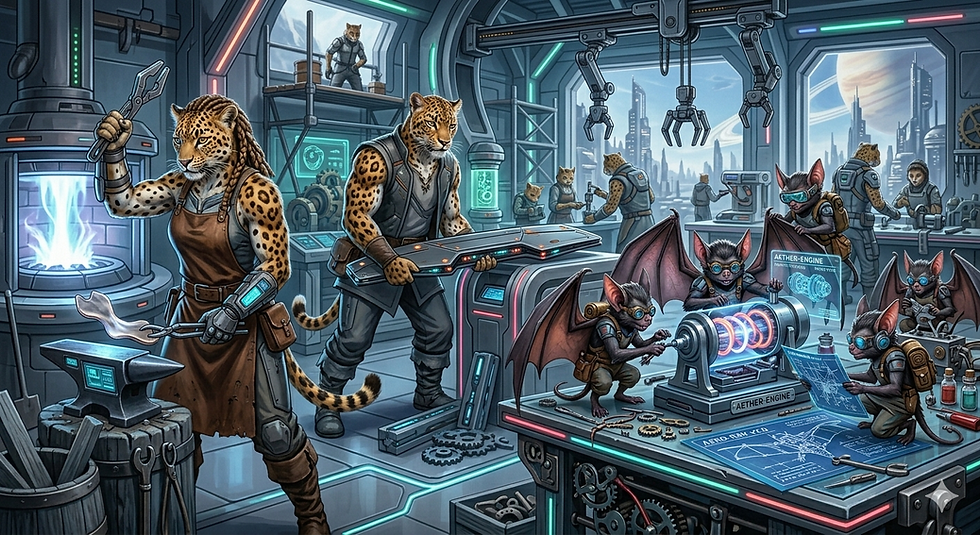
Galactic expansion. The two species that comprise this planet’s populace have very different strengths. The leopard-like pentapardi are strong and industrious. The bat-like tadaribrae are innovative, especially when it comes to engineering disciplines. Together, they can build spacecraft and map the stars. And they need a formal body to keep them working towards that goal. That’s where the United Barpadai Nation comes in.
But how does this multi-species governance work? Let’s dig into that a little bit.
Multi-Species Governance Starting Points and Ideas
Here’s a multi-species governance starting point. Think of a multi-species populace as people. Just. People.
So, instead of considering “species” to be a defining attribute, reflect on aspects like culture, body type, or perception. This helps put the focus on the areas that are typically managed by a government's core functions.
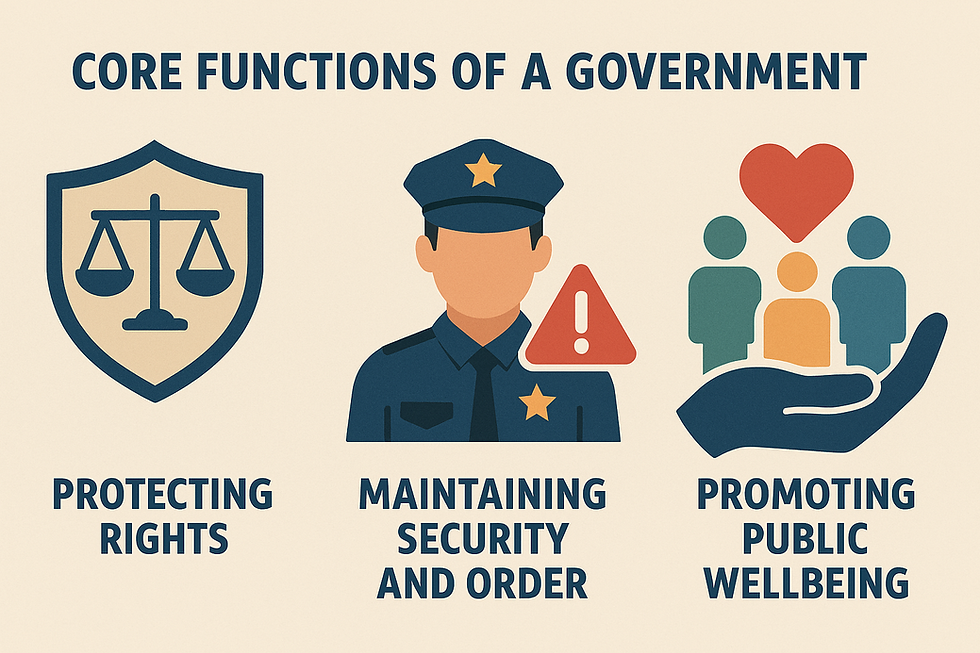
Responsibilities that include protecting rights, maintaining security and order, and promoting public wellbeing.
Walking through a hypothetical build: Let’s say a government has an insect species, an avian species, and a felid species. Immediately, you may imagine that this government focuses on managing feeding instincts.
But, that’s not the sort of thing a government spends much of its time on.
If we make this scenario more about the people, you could divide the needs into those of plant eaters and meat eaters. And perhaps some of the insects eat meat while many of the felids are vegetarians for moral reasons.
With this alternate perspective, you can have the government focus on things like resource management for ensuring there’s enough food, or maybe food and pharmaceutical administration for those with unnatural diets.
Now, we’re looking at health rights and food security.
To get started with this approach, make a list of beliefs and activities people in this culture commonly feel entitled to. What makes most people feel safe? And what public goods and services are needed by a large number of the people?
Remember that needs are different for different people, so you may have several, potentially conflicting answers to each of these three ideas.
From there, you can reference your government type to detail: What (and whose) rights the government focuses on protecting. How the government maintains security and order. As well as if, and how, the government cares for the public.
Using my previous hypothetical. Maybe the plant eaters have more power and the culture governed is hierarchical. The government that aligns with this idea may have a plant-eating monarch who reserves large swaths of land for farming and no grazing areas.

Or, you could take an approach like I did with the peoples of Barpadai.
Because the planet’s population is so large and there are so many diverging beliefs, I decided that only matters of planetary importance are settled by the leaders of the United Barpadai Nation. Everything else is handled by more localized governments.
Again, think United Nations.
So, what is it that a local government is dealing with?
Designing a Fictional Civil Service that Matches the Mythos
Designing a fictional civil service can be one of the most creative and most involved aspects of building a fictional government from scratch.
I say this because the particulars of a government’s responsibilities are open to your imagination. In the real world, our governments are stumped by things like AI and healthcare. If you have a world of fire breathers or weather changers, your government departments are going to be wild.
At the same time, designing a fictional civil service can really lose you in the weeds. So remember to only build as much as you need for your reference or for the progression of the narrative.
That said, you’ll want to take the ideas we’ve talked about one step further here.
Core functions of a government break down into departments and sub-governences depending on values and norms. “Safe” can mean a multitude of things. For instance, a society’s people may feel safe when they’re healthy and mentally well.
A responsible government for this society may invest in healthcare and seek to resolve conflicts through alliances or compromise rather than war.
Similarly, a society built around the ideals of independence and autonomy is likely to have a populus that feels “safe” when their government is not involved in everyday affairs.

And as to the size and scale of administrative bodies, small groups are usually easier to manage than large ones. So when a group becomes too big to manage, subgroups often form. With governments that manage vast lands or large populations, there are often smaller authorities like municipal governments.
So for this portion of your worldbuild, ask yourself: What levels of government exist? Here, you could be looking at national or regional entities.
And with those levels in mind, who deals with large- versus small-scale issues? What is the makeup of each of these bodies? How do they ensure tasks are completed?
My approach to the United Barpadai Nation leads to a very complicated set of answers to these questions. Since this is a planetary alliance, each sub-government is its own entity with a different structure and set of values.
Some are based on science, while others focus on religion. Economic dominance is a driving force for yet another.
But as I said, I don’t have to detail it all. Just what I need.
The part I focused on is the United Barpadai Nation, a worldbuild I’ll walk you through in a couple weeks.
Until next time, stay inspired


